


Machine Learning
One of the key challenges in applying machine learning to Space Domain Awareness is the scarcity of usable data. Much of the relevant observational data is over-classified or was not collected with ML applications in mind. However, spectral data obtained from transmission gratings provides a promising starting point — there is now enough to begin developing classification algorithms.
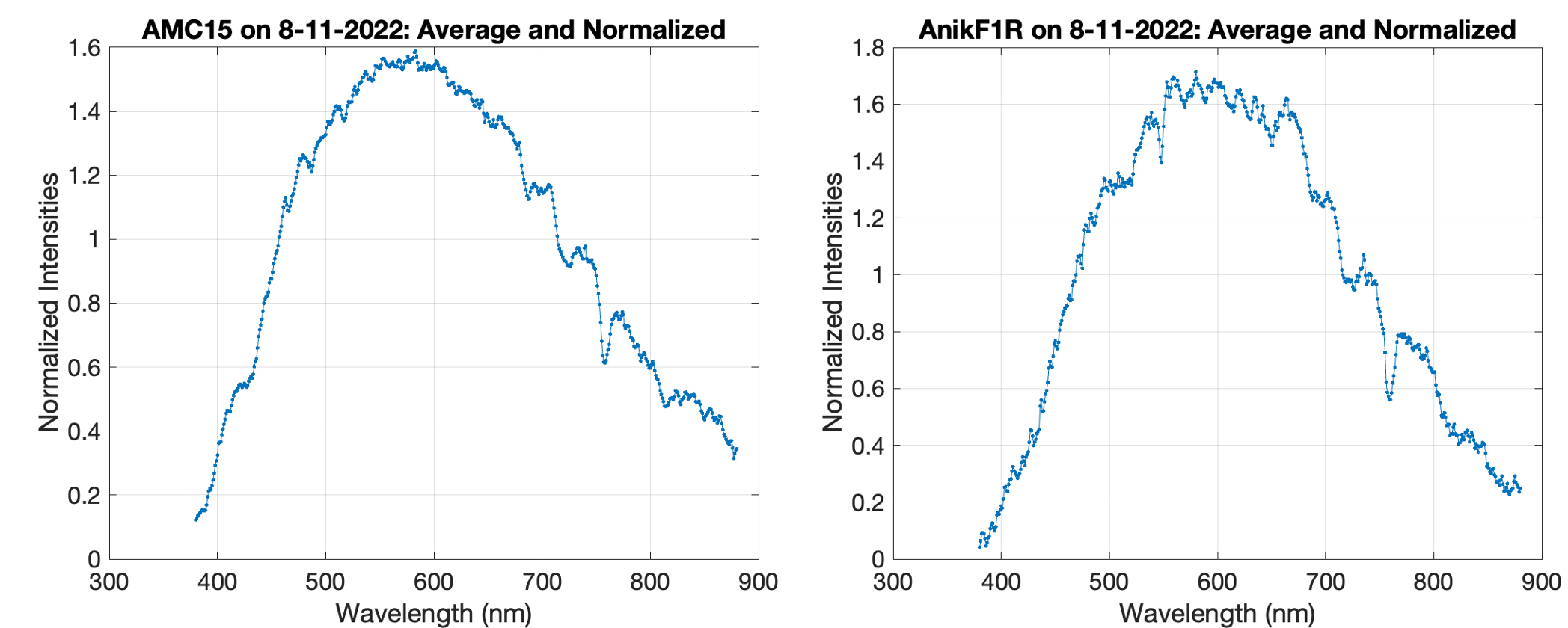
Deviations of satellite spectra from a solar black body curve arise from the material interactions of sunlight reflecting off the satellite surface. The central research question is whether these spectral signatures contain enough discriminating information to distinguish between different types of satellites.
Artificial Intelligence
Strong EO Imaging is actively researching potential applications of AI to Space Domain Awareness, including deep learning approaches for satellite classification from unresolved spectral and photometric data.
Recommended Reading
- Deep Learning from Curiosity to Mastery by A. Elsaedi (Volumes 1 & 2) — Great examples and easy to follow.
- Machine Learning with PyTorch and Scikit-Learn (Packt Publishing) — A very good reference for getting started with PyTorch.
- AI Engineering by Chip Huyen — The best available explanation of the foundations of modern AI and large language models as they are implemented today.
References
- Yee, X., Dao, P., Strong, D., Wetterer, C., Roth, B., & Chun, F. (2023). Machine Learning Classification GEOs Using Spectral Data. Proceedings of the Advanced Maui Optical and Space Surveillance (AMOS) Technologies Conference, 209.
- Landon, G., Strong, D., Giblin, T., Roth, B., & Chun, F. (2025). Deep Learning Based Classification of GEOs using Unresolved Spectral Data. The Advanced Maui Optical and Space Surveillance (AMOS) Technologies Conference, 111.
- Chun, F., Giblin, T., Strong, D., Roth, B., Jones, K., Fishbein, P., Chaudhary, A., & Wetterer, C. (2024). ML-Based Photometric Fingerprinting at Scale for LEO Satellite Monitoring. Proceedings of the Advanced Maui Optical and Space Surveillance (AMOS) Technologies Conference, 123.
- Strong, D. M., Marcy, I., Giblin, T. W., & Chun, F. K. (2024). Development of hyperspectral polarimetry of geosynchronous satellites. Unconventional Imaging, Sensing, and Adaptive Optics 2024, SPIE, 13149, 202–210.
- Strong, D., Wetterer, C. J., Giblin, T., Fitzgerald, M. S., & Chun, F. (2023). Initial Spectral Polarimetry of Geosynchronous Satellites. Proceedings of the Advanced Maui Optical and Space Surveillance (AMOS) Technologies Conference, 185.
- Strong, D. M. (2001). Implementation and Analysis of the Parallel Genetic Rule and Classifier Construction Environment. Technical Report.